

Ask a supplier whether a compressed wood pallet will take your load and you will usually get a single number back. On its own, that number tells you very little. Every pallet carries three separate load ratings, and reading the wrong one is how a consignment ends up on the floor of a warehouse in Kewdale or sitting on a wharf while somebody sources a replacement.
The honest answer is that compressed wood pallets are strong enough for a great deal of heavy freight. Whether they are strong enough for yours comes down to how the weight sits on the deck, how the pallet gets handled between your floor and your customer, and whether it ever goes into racking. This guide covers the figures that matter, where presswood performs well, and the point at which you should be looking at a different load device.
KEY TAKEAWAYS
- Compressed wood pallets carry heavy freight well, but static, dynamic and racking ratings are not interchangeable.
- Racking is always the lowest figure, so never spec a pallet from its static number.
- Presswood suits evenly distributed loads and one way export; concentrated point loads belong on timber skids.
- Presswood is exempt from ISPM-15 as processed wood, so no heat treatment stamp is required.
1. The short answer, and the catch that comes with it
Compressed wood pallets, also sold as presswood or moulded wood pallets, are formed by pressing recycled wood fibre under high heat and pressure into a single moulded shape. There are no boards, no nails and no joints, so strength comes from the density of the pressing and the rib geometry moulded into the underside rather than from fasteners that can work loose in transit. You can see the full specification range on our compressed wood pallets page.
In practice, that construction handles a tonne or more under a forklift without any drama. For most palletised export consignments leaving Perth, capacity is not the limiting factor. Weight, space and border compliance usually decide the pallet before strength does.
The catch is uniformity. A moulded deck carries weight beautifully when the load is spread across it and much less well when the same weight is concentrated on a small bearing area. Timber is more forgiving of point loading, because the bearers underneath run the full length of the pallet and can be specified thicker where the load demands it. Presswood asks you to think about how the load sits, not just what it weighs.
2. Static, dynamic and racking: three numbers that are not interchangeable
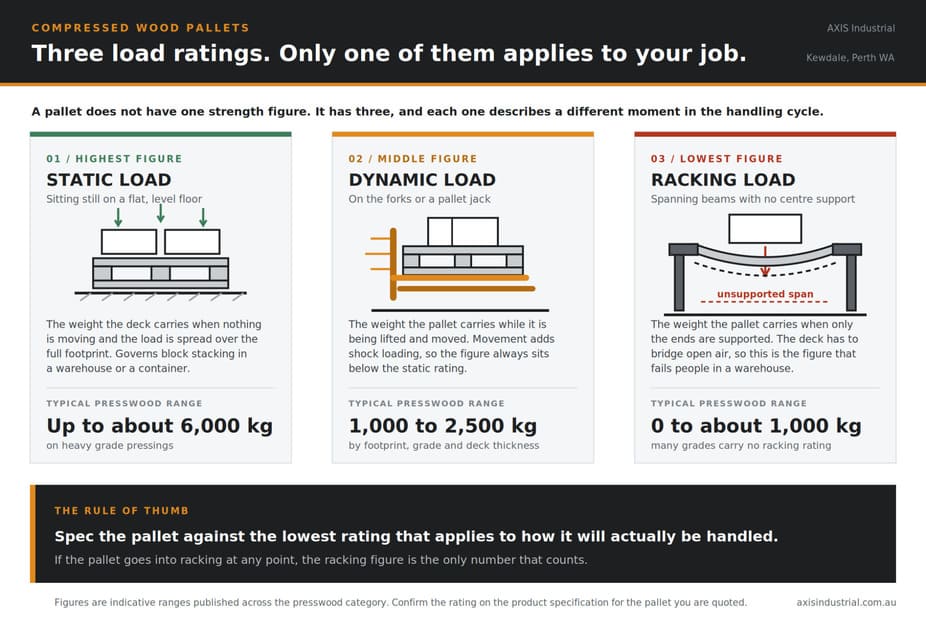
Every pallet, in every material, carries three load ratings. They describe three different moments in the handling cycle, and each one is lower than the last. Most of the confusion in pallet specification comes from quoting one figure and applying it to a situation it was never measured for.
Static load
Static load is the weight the pallet supports while stationary on a flat, level floor, with the load spread over the full footprint. It is always the highest of the three, because the concrete underneath is doing most of the work. This is the figure that governs block stacking in a warehouse or floor loading a sea container. Published static ratings across the presswood category run up to roughly 6,000 kg on heavy grade pressings.
Dynamic load
Dynamic load is what the pallet carries while it is being lifted and moved on forks or a pallet jack. Movement introduces shock, the load shifts on the deck, and the pallet has to span the tines rather than rest on concrete, so the rating drops. Presswood dynamic ratings generally sit between 1,000 kg and 2,500 kg depending on footprint, grade and deck thickness. For context, a standard 1200 x 1000 mm timber pallet lands in a comparable band, which is why custom timber pallets and presswood often come down to weight and compliance rather than raw strength.
Racking load
Racking load applies when the pallet sits on beams with nothing supporting the centre. The deck has to bridge open air, so this is always the lowest of the three figures and the one most often ignored. Many presswood grades carry no racking rating at all. Where a rating is published, it typically tops out near 1,000 kg.
If the pallet goes into racking at any point in its life, the racking figure is the only number that counts. It makes no difference that the static rating is four times higher. The load will find the weakest condition in the cycle, and in a warehouse that condition is almost always the beam span.
3. What actually sets the capacity of a compressed wood pallet
Two presswood pallets of the same footprint can be rated hundreds of kilograms apart. These are the variables that move the number.
- Pressing density and grade. Light, medium and heavy duty pressings use different fibre volumes and compaction pressures. The heavy grades cost more per unit and carry considerably more.
- Deck thickness and rib geometry. The moulded ribs on the underside are the structural element. Deeper, better distributed ribs resist deflection across an unsupported span, which is what lifts a racking rating.
- Resin system. Urea formaldehyde, melamine urea formaldehyde and MDI binders behave differently under humidity. The binder affects both strength retention and how the pallet copes with a damp container.
- How the load sits. A 1,200 kg load spread over the whole deck and a 1,200 kg load resting on four small feet are not the same job. Concentrated point loads need spreader boards, dunnage or a different load device.
- Entry direction and tine placement. Four way entry gives handlers options, but a pallet lifted across its weak axis will deflect more than the same pallet lifted along its strong one. Brief the site, not just the buyer.
- Moisture and storage. Presswood resists moisture, it is not waterproof. Pallets stored uncovered, or left sitting in water in a container, will lose capacity. Keep stock dry and off the ground.
4. Compressed wood, timber or plastic: how the options compare
The table below sets out indicative figures across the three materials AXIS supplies most often. Treat the numbers as category ranges for shortlisting rather than product specifications. Confirm the rating on the spec sheet for the pallet you are actually quoted.
| Criteria | Compressed wood | Custom timber | Plastic |
|---|---|---|---|
| Typical static load | Up to about 6,000 kg on heavy grades | 3,000 to 4,000 kg on a 1200 x 1000 footprint | 4,500 to 7,500 kg on heavy duty models |
| Typical dynamic load | 1,000 to 2,500 kg | 1,000 to 1,500 kg | 1,250 to 2,250 kg |
| Typical racking load | 0 to 1,000 kg, and often unrated | 600 to 1,000 kg | 1,000 to 1,800 kg on rackable models |
| Tare weight | Light | Moderate to heavy | Light to moderate |
| ISPM-15 position | Exempt as processed wood, no stamp needed | Requires heat treatment and an IPPC mark | Exempt, not a wood product |
| Point load tolerance | Low to moderate, needs spreading | High, and can be engineered to the load | Moderate, varies by deck design |
| Sizes available | Standard moulded footprints only | Any size, built around the load | Standard moulded footprints only |
| Trip profile | One way, not retrieved | Repairable and multi trip | Long service life, needs retrieval |
| Best suited to | Air freight, one way export, distributed loads | Heavy, irregular, mounted or braced loads | Closed loop, hygiene critical, returnable systems |
If your shortlist is between the last two columns, our guides on plastic pallets and heavy duty skids cover those decisions in more detail.
5. When a compressed wood pallet is the wrong call
Being straight about the limits is more useful than overselling the product. There are five situations where we will steer a customer away from presswood.
Concentrated point loads
Machined components, steel sections, castings and frames that sit on small feet all put their weight through a handful of contact points. A moulded deck will dish under that. Load devices with full length bearers, such as heavy duty skids or purpose built wooden cases, spread the load properly and can be reinforced where it lands.
Anything that has to be fixed down
If the item needs bolting, lag screwing or through fixing to its base for the journey, presswood is the wrong substrate. Fasteners need timber to bite into. This is standard for pumps, gearboxes, skid mounted packages and most rotating equipment heading to a mine site.
Long term racked storage
Presswood is built as a transport and export pallet. If the consignment is going to sit in racking for months at a customer distribution centre, specify a pallet with a published racking rating that covers the load with margin, and confirm the beam span it will sit on.
The Australian 1165 x 1165 footprint
The Australian standard pallet is 1165 x 1165 mm under AS 4068, sized for rail containers and used widely in domestic racking. Presswood is moulded to international footprints such as 1200 x 1000, 1200 x 800 and 1100 x 1100. If your receiver runs 1165 profiles in their racking or their conveyors, check the fit before you commit to a run.
Returnable and multi trip programmes
Presswood is a single trip pallet by design, and its economics assume it is not coming back. If you operate a closed loop with retrieval, a repairable timber pallet or a rackable plastic pallet will cost less per trip over a year.
6. What we see on Perth export lanes
Most of the compressed wood pallets leaving our Kewdale facility go out on export and air freight work, and a few patterns come up on nearly every job.
Tare weight comes off every freight bill
On air freight, chargeable weight is the whole game. Swapping a heavier timber pallet for presswood takes kilograms off every consignment, and across a shipping programme that difference usually outweighs any unit price gap. The nestable profile also means you store and truck far more empties in the same footprint, which matters when yard space in the industrial corridor is tight.
The ISPM-15 exemption is real, but it is narrower than people think
Presswood is classified as processed wood under ISPM-15, because the manufacturing process combines glue, heat and pressure in a way that eliminates pest risk. It does not need heat treatment, fumigation or an IPPC stamp, which removes a common source of border delay and rejected consignments.
The part that catches exporters out is scope. The exemption applies to the presswood pallet, not to the consignment as a whole. If you pack that pallet into a case with solid timber bracing, chocks or wooden dunnage, that timber still has to be treated and marked. We check the whole pack, not just the base.
Moisture is the quiet risk on a sea leg
Container rain is a genuine problem out of a humid port, and the coastal salt load in WA does the rest. Presswood resists moisture but will take on water if it sits in it. For anything sensitive we pair the pallet with VpCI films, desiccants or container liners so the pallet is not the only thing standing between the cargo and the climate.
Securing the load matters more on a light pallet
A lighter pallet gives the load less inertia to work against, so restraint does more of the work. Correctly tensioned strapping with edge protectors keeps the stack tied to the deck and stops strapping from cutting into the moulded edge under tension.
7. How we spec a pallet against a real load
We do not quote a pallet from a weight figure alone. The process runs the same way on every job.
- Measure. Dimensions, actual weight, centre of gravity, and the bearing area where the load contacts the deck.
- Design. Match the footprint, grade and entry type to the handling cycle, including every lift between your floor and the final destination.
- Secure. Specify strapping, dunnage and edge protection so the load stays tied to the pallet through the whole journey.
- Protect. Add corrosion and moisture protection where the route, the season or the cargo calls for it.
That process is free, and it takes one site visit. If you are weighing up presswood against timber for a shipping programme, get in touch with our team and we will spec it against the actual load rather than a catalogue number.
8. Closing thoughts
Compressed wood pallets are stronger than their reputation suggests. The lightweight, nestable profile leads people to assume they are a budget option for light goods, when the reality is that a heavy grade pressing will carry a tonne and a half under a forklift and sit under a stack that weighs several times that on a flat floor.
The mistake is not choosing presswood. The mistake is choosing any pallet from one number. Work out how the load will be handled at every stage, identify the lowest rating that applies across that cycle, then check how the weight is distributed across the deck. If the answer is even loading and one way export, presswood is a strong and economical choice. If the answer is point loads, fixings or long term racking, timber will serve you better and cost less in damaged goods.
AXIS Industrial supplies compressed wood pallets, custom timber pallets, heavy duty skids and plastic pallets from our Kewdale facility to customers across Perth, regional WA and international supply chains.

